
Pipe Manufacturer Turns to RICO to Fight High‑Volume Asbestos Firms
Asbestos litigation, a constant for over fifty years and driven by a small group of high-volume plaintiff firms, shows no sign of waning. In recent months, however, one high-volume defendant has taken the offensive by filing lawsuits against two plaintiff firms alleging systemic fraud and seeking recovery, among other theories, under the federal Racketeer Influenced and Corrupt Organizations Act (RICO). This is not a novel theory, having been successfully used in some notable past cases, but it has been dormant for more than a decade.
MGS is no stranger to defending industrial clients against serial asbestos lawsuits (MGS Helps Industrial Client End Nearly Decade-Long Series of Dubious Exposure Cases) but these RICO suits are of real interest because they provide an unusually detailed look at the (alleged) operations of two national asbestos plaintiff firms and reflect a rekindling of long‑simmering disputes over the integrity of asbestos litigation practices.
Background: J‑M Manufacturing’s Asbestos Litigation History
J‑M Manufacturing, a producer of asbestos‑cement pipe (ACP) between 1983 and 1988, has been a frequent defendant in asbestos exposure cases for decades. According to the complaints, firms such as Simmons Hanly Conroy LLP and The Gori Law Firm have filed hundreds of lawsuits against J‑M, many of which – J‑M alleges – were based on fabricated exposure narratives, coached testimony, and concealed evidence.
J-M filed a complaint against Simmons in 2024 in the Northern District of Illinois seeking recovery under RICO and various state law theories. The district court dismissed the RICO counts in March 2025 (and declined jurisdiction over the state claims) but thereafter allowed J-M to amend to clarify its RICO enterprise allegations. In November 2025, J-M filed a substantially expanded amended complaint (Simmons Amended Complaint).
In January 2026, J‑M filed a separate RICO lawsuit in the Southern District of Illinois against Gori, alleging a similar pattern of misconduct (Gori Complaint). Together, these complaints illustrate an aggressive and coordinated litigation strategy by one manufacturer defendant targeting what J‑M characterizes as fraudulent mass‑tort practices.
Key Allegations in the Gori and Simmons RICO Complaints
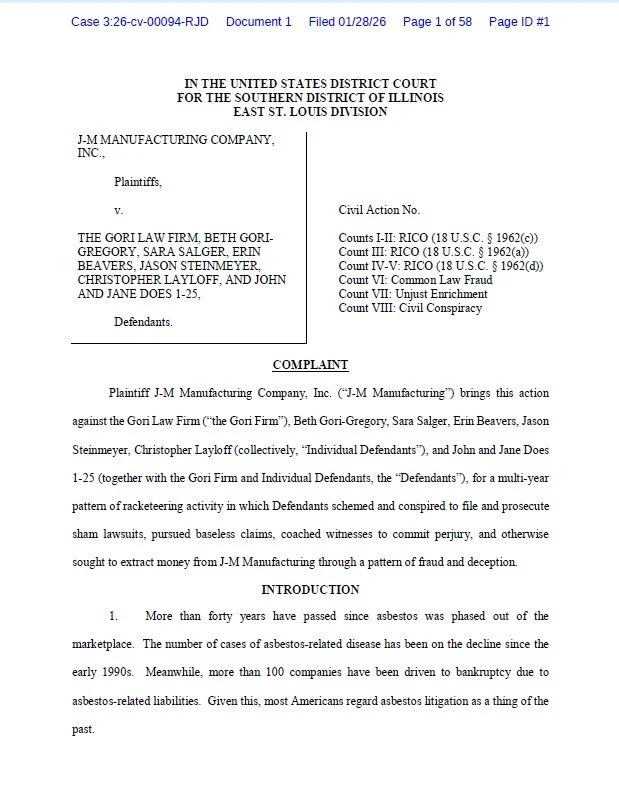
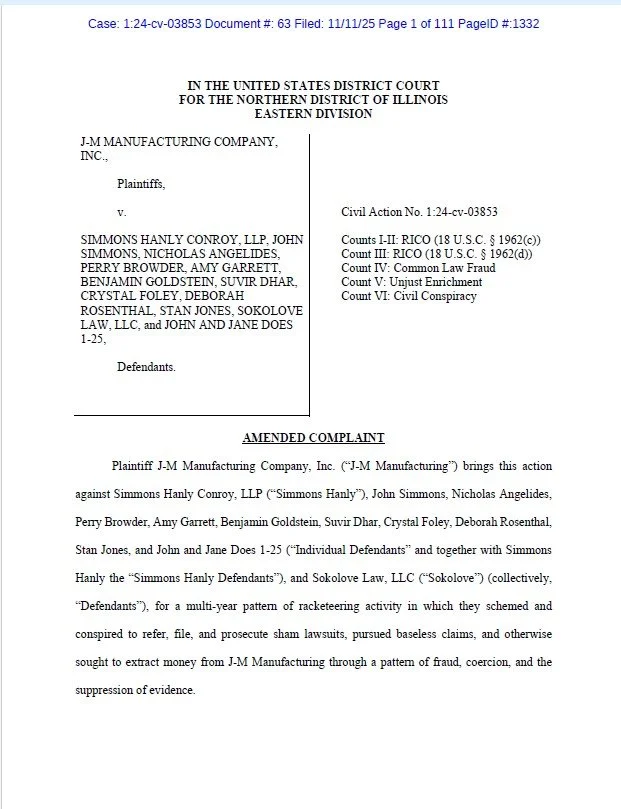
Both the Simmons and Gori complaints allege multi‑year schemes designed to file sham asbestos lawsuits to extract settlements. J‑M asserts the firms:
manufactured exposure narratives disconnected from plaintiffs’ actual work histories;
encouraged or coached witnesses to testify falsely;
avoided disclosure of asbestos‑bankruptcy trust claims until after tort depositions;
used large volumes of weak or impossible‑to‑prove cases as “bargaining chips” in global or batch settlements.
Across both filings, J‑M stresses that many cases involved plaintiffs whose work histories either pre‑dated J‑M’s existence or bore no occupational connection to ACP.
Both complaints describe what J‑M calls “fraud playbooks” though each with distinct attributes:
the Gori complaint highlights an alleged “bounty system” rewarding deposition attorneys for securing identifications of targeted solvent defendants such as J‑M;
the Simmons complaint describes a scheme involving scripted testimony, evidentiary suppression, and coordination with Sokolove Law – alleged to be a national lead‑generation operation feeding cases to the Simmons firm;
both complaints rely on information disclosed by insiders – a former partner in the Simmons complaint and a deposition associate in the Gori complaint.
RICO Enterprise Theories and Predicate Acts Alleged Against Gori and Simmons
The complaints advance both a legal‑entity enterprise (the law firms themselves serve as RICO enterprises distinct from the individuals operating them) and an association-in-fact enterprise (alleged networks include firm partners, deposition attorneys, referral firms, investigators, and others who purportedly functioned as coordinated units).
The asserted predicate acts include mail fraud and wire fraud (e.g., transmitting pleadings, settlement communications, trust claim submissions) and obstruction‑related conduct such as witness coaching or suppression of trust‑claim evidence.
J‑M claims injuries in the form of inflated settlements, defense costs, and distortions in case valuation due to fabricated exposure evidence.
What These RICO Suits Might Mean for the Future of Asbestos Litigation

These RICO suits mark a significant shift in asbestos litigation – from defending individual cases to challenging the business models and conduct of high‑volume asbestos firms. If successful, these lawsuits could alter the landscape of asbestos litigation, potentially affecting case‑generation practices, trust‑claim disclosure norms, and settlement dynamics. On the other hand, it’s been said that one way to ruin a perfectly good fraud claim is to add a RICO count. RICO is hyper-technical (as the dismissal of J-M’s initial Simmons complaint shows) and judges hate it. J-M faces extensive motion practice and briefing before even getting the opportunity to prove its case, leaving the cost-benefit calculation a little cloudy.
Nevertheless, there is precedent for successfully using RICO against asbestos plaintiff lawyers. In CSX Transportation, Inc. v. Peirce, Raimond & Harron, CSX alleged that two plaintiffs’ asbestos lawyers and a retained radiologist conspired to manufacture and litigate fraudulent asbestos claims, including false medical diagnoses used to support lawsuits against CSX. A federal jury in the Northern District of West Virginia found the lawyers civilly liable under RICO, concluding they engaged in a pattern of racketeering activity through fraudulent litigation filings. Damages were trebled under RICO, and the case ultimately settled for $7.3 million covering the judgment, defense costs and attorney’s fees.
Takeaways
Whether J-M can achieve that kind of success, or its other perhaps non-monetary goals, will be worth watching as these cases play out in the coming months. And whether this direct approach is right for other companies - even high-volume defendants - is debatable. Most will continue their historic strategies - either entering early nuisance settlements or defending aggressively to the point that suits against them no longer make economic sense under the plaintiffs’ business model. All these strategies can be effective, and none of them is costless.