Illinois Appellate Courts Reexamine Sole Proximate Cause Instructions After 2021 IPI Revisions
INTRODUCTION
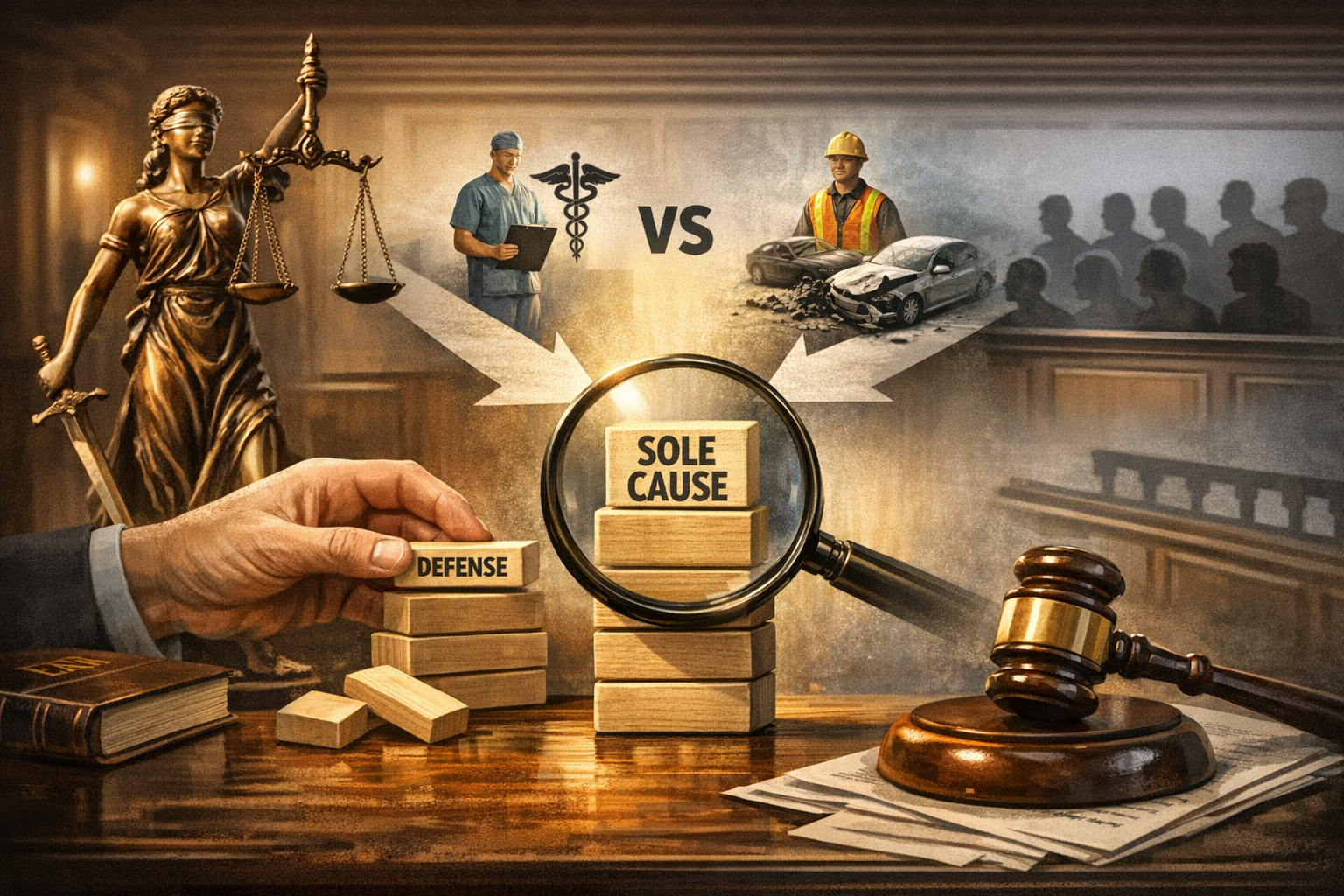
Over the last year, the Illinois Appellate Court has addressed whether the revised Illinois Pattern Jury Instructions on proximate cause accurately reflect Illinois law when a defendant advances a sole proximate cause theory. In three recent First District decisions—Johnson v. Advocate Health & Hospitals Corp., Abraham v. Advocate Health & Hospitals Corp., and White v. Advocate Condell Medical Center—the court confronted trial‑level disputes over whether juries must be expressly instructed that a third party or other factor may be the sole cause of a plaintiff’s injury.
Taken together, these opinions clarify that while the 2021 revision to IPI Civil 15.01 correctly states general proximate‑cause principles, it does not fully capture a defendant’s right—recognized for decades under Illinois Supreme Court precedent—to present and receive an instruction on a sole proximate cause theory when supported by the evidence.
Background: The 2021 Revision to IPI 15.01
Before August 2021, Illinois courts commonly instructed juries on sole proximate cause using IPI Civil 12.04 and 12.05. Those instructions explicitly directed jurors to return a defense verdict if they found that the plaintiff’s injury was caused solely by someone or something other than the defendant.
In 2021, the Supreme Court Committee on Jury Instructions withdrew IPI 12.04 and 12.05 and revised IPI 15.01 in an effort to “harmonize” proximate‑cause instructions and reduce confusion surrounding the word “sole.” The revised instruction emphasizes two concepts:
A defendant is not relieved of liability merely because another person or factor also contributed to the injury; and
The jury should find for the defendant if it concludes the defendant’s conduct was not a proximate cause of the injury.
What the revision omitted, however, was any express statement of the sole proximate cause theory recognized by the Illinois Supreme Court in Leonardi v. Loyola University of Chicago and its progeny.
Johnson v. Advocate Health: IPI 15.01 is Incomplete
The First District squarely addressed this omission in a May 2025 opinion in Johnson v. Advocate Health & Hospitals Corp. The defendant hospital argued that the child’s neurological injuries were caused exclusively by fetal growth restriction rather than any alleged negligence during labor and delivery. The trial court declined to give the defendant’s proposed instruction expressly referencing sole proximate cause and instead delivered revised IPI 15.01.
On appeal, the court held that revised IPI 15.01 “fails to provide an instruction on sole proximate cause” and that the defendant was entitled to a non‑pattern instruction explaining that a third factor could be the sole cause of the injury. Relying on Leonardi, the court emphasized that Illinois law recognizes two distinct but related concepts: rebutting proximate cause generally and affirmatively establishing that some other factor exclusively caused the injury.
Although the appellate court ultimately affirmed the verdict—concluding the defendant had not suffered serious prejudice—it made clear that the absence of a pattern instruction does not eliminate the right to a sole proximate cause instruction when the evidence supports it.
Abraham v. Advocate Health: Error Without Reversal
Abraham v. Advocate Health & Hospitals Corp., decided in December 2025, addressed a similar issue in the context of a medical malpractice verdict. As in Johnson, the trial court instructed the jury using revised IPI 15.01 and rejected the defendants’ request for language explicitly addressing sole proximate cause.
The First District again acknowledged that the revised instruction does not expressly state the sole proximate cause defense. The court reiterated that a defendant is entitled to have the jury instructed on any theory supported by the evidence, including that another cause entirely explains the injury.
Nevertheless, the court declined to disturb the verdict. Consistent with long‑standing Illinois precedent, it emphasized the “serious prejudice” standard governing instructional error and noted that appellate courts are reluctant to reverse verdicts absent a clear showing that the jury was misled.
White v. Advocate Condell: Reinforcing the Posture on Appeal
The court returned to the issue in White v. Advocate Condell Medical Center, where the defendants again argued that the trial court erred by refusing to instruct the jury using withdrawn IPI 12.05 or equivalent sole proximate cause language. The defense theory focused on an alternative medical explanation—a rare clot‑in‑transit—as the true cause of the decedent’s death.
The appellate court reaffirmed two points that now appear settled. First, revised IPI 15.01 does not expressly convey the sole proximate cause concept recognized in Illinois case law. Second, the failure to give such an instruction will not automatically require reversal. Where the jury is otherwise properly instructed on proximate cause and the defendant can argue its theory to the jury, the absence of a sole cause instruction may be deemed harmless.
The Emerging Consensus
Across these decisions, several themes emerge:
Recognition of Inaccuracy: The appellate court has repeatedly acknowledged that the revised IPI 15.01 does not fully reflect Illinois law regarding sole proximate cause.
Continued Viability of the Defense: Courts continue to recognize that defendants may present evidence and argument that another person or condition was the exclusive cause of the plaintiff’s injury.
Appellate Reluctance to Reverse: Even where a trial court errs in refusing a sole proximate cause instruction, reversal remains unlikely absent a strong showing of prejudice.
These principles align with the broader principle that sole proximate cause is not an affirmative defense but a method of negating the plaintiff’s burden of proof on causation—a distinction sometimes obscured by the current pattern instructions.
Practical Implications for Defendants
For defense trial counsel, these cases underscore several practical considerations:
Instruction Conferences Matter: Defendants should continue to tender modified or non‑pattern instructions expressly addressing sole proximate cause when the evidence supports that theory, even if the trial court is reluctant to give them.
Record Preservation Is Critical: Because appellate courts apply a demanding prejudice standard, preserving objections and making a clear record remains essential.
Pattern Instructions Are Not Dispositive: Trial courts’ reliance on the revised IPI alone does not foreclose the availability of a sole proximate cause instruction under Illinois law.
At the same time, these decisions highlight the institutional hesitation of reviewing courts to upset jury verdicts based solely on instructional nuance. As a result, defense efforts to clarify the law through further appellate review or through amendments to the pattern instructions themselves may continue.